

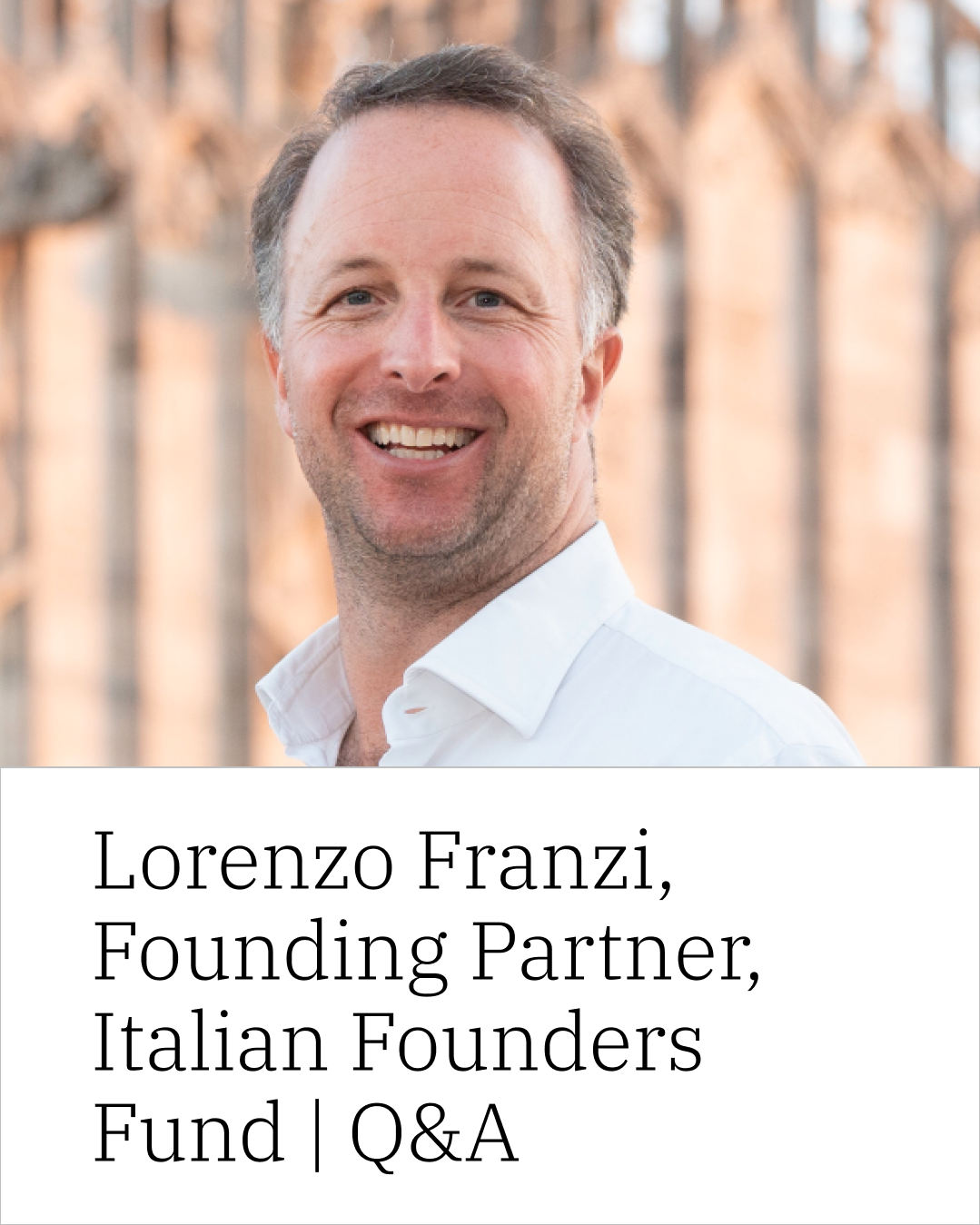
 What have been your biggest learnings at Jet HR, Zipjet, Flash Ventures, JP Morgan, etc and how have you applied them to your role at Italian Founders Fund and portfolio companies?
Each chapter taught me something different. JP Morgan gave me rigour and financial fluency. Co-founding Zipjet with Rocket Internet taught me rapid and ambitious venture building but also how hard it is. Investing with GFC showed me the gap Italian founders faced at pre-seed. Jet HR, IFF’s first deal, confirmed the rest: back exceptional founders early, then be useful and very community driven. At IFF, that means disciplined tickets and founders helping founders.
IFF has a distinctive proposition, particularly a founder-backed community rather than a source of capital. So what does Italian DNA actually mean when making an investment decision, and what is the difference between building a great company IN Italy and building a great company FROM Italy?
Italian DNA isn’t a passport check. It means founders connected to Italy: building here, expanding here, or Italians building abroad. When we invest, it means we can unlock our strongest asset our Community. Italy offers: world-class engineers, a deep industrial base, and we have 100+ founder-LPs, from Bending Spoons to King, who pick up the phone. Building IN Italy means serving the domestic market well. Building FROM Italy means using Italy’s talent, cost base and industrial know-how to win globally. Compri is a good example: it was born from Italian manufacturing expertise and built to scale internationally. That second category is what we’re here for.
Can Italy produce the next generation of global tech companies, and should an Italian startup think globally from day one?
Yes, and I think we’re closer than people realise. I saw Paris in 2012. It had state-backed capital, a few breakout companies, and then exited founders reinvesting in the next generation. Italy is following the same sequence a few years behind, and IFF’s own LP base is proof of that flywheel. On thinking globally: It is a development that has started but I think yes to global ambition from day one, meaning product, team and cap table built to travel. That doesn’t mean launching in ten markets at once. Italy can be a valuable proving ground, but it can’t be the ceiling.
Italy is seen as low on innovation-friendly regulation due to bureaucratic complexity, slow administration, tax complexity, etc. Do you agree?
Partly. The friction is real. Stock option taxation makes it harder to retain talent, labour rules are rigid for fast-moving tech teams, and administration can be slow and unpredictable. But the picture has improved meaningfully. The innovative startup regime and CDP Venture Capital’s role as an anchor investor have improved the situation. And for having run Zipjet also in France and Germany I can tell you that Italy is not worse.
’Staff at leading AI groups suffer mental strain on fears of causing societal harm’ (FT23.09.26). Are you concerned by the so-called ‘gambling with the future of humankind’?
I take it seriously. When the people building frontier models express concern, dismissing them would be arrogant. But I’d separate two debates. One is about frontier labs and long-term risk, which needs serious governance, and Europe should be at that table rather than just regulating from the sidelines. The other is applied AI: using these tools to modernise slow, under-digitised sectors like manufacturing, HR and healthcare administration. That’s where most of our portfolio operates. Our responsibility as investors is to back founders who think about misuse and consequences as part of building well, not as an afterthought.